How Much Yarn for a Crochet Blanket by Size and Yarn Weight
Running out of yarn halfway through a blanket is every crocheter’s nightmare. Here’s how much yarn for a blanket you really need, by size, yarn weight and stitch, so you can buy with confidence.
How Much Yarn Does a Crochet Blanket Need
A crochet throw blanket measuring about 50 × 60 inches usually needs 1,800 to 2,550 yards of worsted weight yarn, which is roughly 9 to 12 skeins of a standard 219 yard skein. A baby blanket needs about 800 to 1,100 yards, and a queen size blanket can need 5,400 yards or more.
The exact amount for your blanket depends on four things:
Size. A bigger blanket needs more yarn, and the amount grows quickly. A queen blanket covers about three times the area of a throw, so it needs about three times the yarn.
Yarn weight. Thicker yarn covers more space with each stitch, so you need fewer yards. A throw in bulky yarn might need around 1,100 to 1,550 yards, while the same throw in DK yarn could need 2,700 yards or more.
Stitch. Short, dense stitches like single crochet use more yarn than taller stitches like double crochet. Textured stitches such as puffs, bobbles and cables use the most.
Tension. If you crochet tightly, you’ll use more yarn to cover the same area. Loose crocheters use less.
How many skeins to buy: work out your estimate, then add 10% to 15% extra. That buffer covers your gauge swatch, the border, any fringe or tassels and the natural variation in tension across a big project. Always buy all your yarn from the same dye lot at the same time, because a second batch of the same color can look noticeably different. If your yarn is labeled “no dye lot,” you have a little more freedom.
The most accurate method is a quick swatch. Crochet a 6 × 6 inch square in your chosen yarn and stitch, measure how much yarn it used, then scale it up to your blanket size. This guide walks you through it step by step.
Below, you’ll find charts for every common blanket size and yarn weight, how stitch choice changes the total, what to do about dye lots and what to do if you run out halfway. Prefer an instant answer? Our free crochet yarn calculator works it out for your exact blanket in seconds.
You’ve picked the perfect blanket pattern. You’ve chosen your colors. Then you stand in the yarn shop, or stare at an online basket, and wonder: how many skeins do I actually need?
So you search for an answer, and that’s where the confusion starts. One chart says a throw needs 1,400 yards. Another says 2,000. A third says 15 skeins. Some guides talk in yards, others in grams, and none of them seem to agree.
Meanwhile, the stakes feel high. Buy too little and you might run out with half a blanket to go, only to find the shop has no more yarn from your dye lot. Buy too much and you’ve spent money on yarn that sits in a bag for years.
This guide clears up the confusion. We’ll explain why estimates vary so much, give you reliable charts for every blanket size and yarn weight, and show you a simple method to work out the exact amount for your own blanket. By the end, you’ll be able to buy your yarn with confidence.
Why Yarn Estimates Online Disagree
If you’ve found wildly different answers online, you’re not imagining it. Most charts are giving you a single number for a question that really has several moving parts. Here’s what changes the answer.
Blankets come in different sizes. One guide’s “throw” might be 50 × 60 inches, while another’s is 40 × 50. That small difference changes the area by 50%, and the yarn changes with it.
Skeins come in different lengths. A skein isn’t a fixed amount. One 100 gram skein of worsted yarn might hold 170 yards, while another holds 220. A big value skein can hold more than 300 yards. So “10 skeins” means very different things depending on the brand.
Yarn weight makes a big difference. A throw in bulky yarn needs far fewer yards than the same throw in DK. Some charts don’t say which weight they mean.
Stitches use different amounts of yarn. A blanket in single crochet uses noticeably more yarn than the same size in double crochet, and a textured bobble blanket uses more still.
Everyone crochets differently. Two people using the same yarn, hook and pattern can use different amounts of yarn because of their tension.
So when a chart gives you one number, it’s usually right for someone, just not necessarily for you. The best approach is to start with a reliable range, then adjust it for your yarn, your stitch and your tension. That’s exactly what the rest of this guide helps you do.
Standard Crochet Blanket Sizes
Before you can estimate yarn, you need to know how big your blanket will be. These are common finished sizes for crochet blankets. Patterns vary, so always check the measurements in your own pattern.
| Blanket type | Common size (inches) | Common size (cm) | Area (square inches) |
|---|---|---|---|
| Lovey or security blanket | 12 × 12 | 30 × 30 | 144 |
| Stroller or pram blanket | 30 × 35 | 76 × 89 | 1,050 |
| Baby blanket | 36 × 36 | 91 × 91 | 1,296 |
| Throw or lap blanket | 50 × 60 | 127 × 152 | 3,000 |
| Twin bed blanket | 66 × 90 | 168 × 229 | 5,940 |
| Full or double bed blanket | 80 × 90 | 203 × 229 | 7,200 |
| Queen bed blanket | 90 × 100 | 229 × 254 | 9,000 |
| King bed blanket | 108 × 100 | 274 × 254 | 10,800 |
Notice the last column. Area is what really drives yarn use. A throw has more than twice the area of a baby blanket, and a queen blanket has three times the area of a throw. That’s why big blankets need so much yarn.
For bed blankets, measure the top of the mattress, then add the drop you’d like on each side. A blanket that hangs further over the edges looks lovely but needs a lot more yarn.
How Much Yarn for A Blanket; by Blanket Size
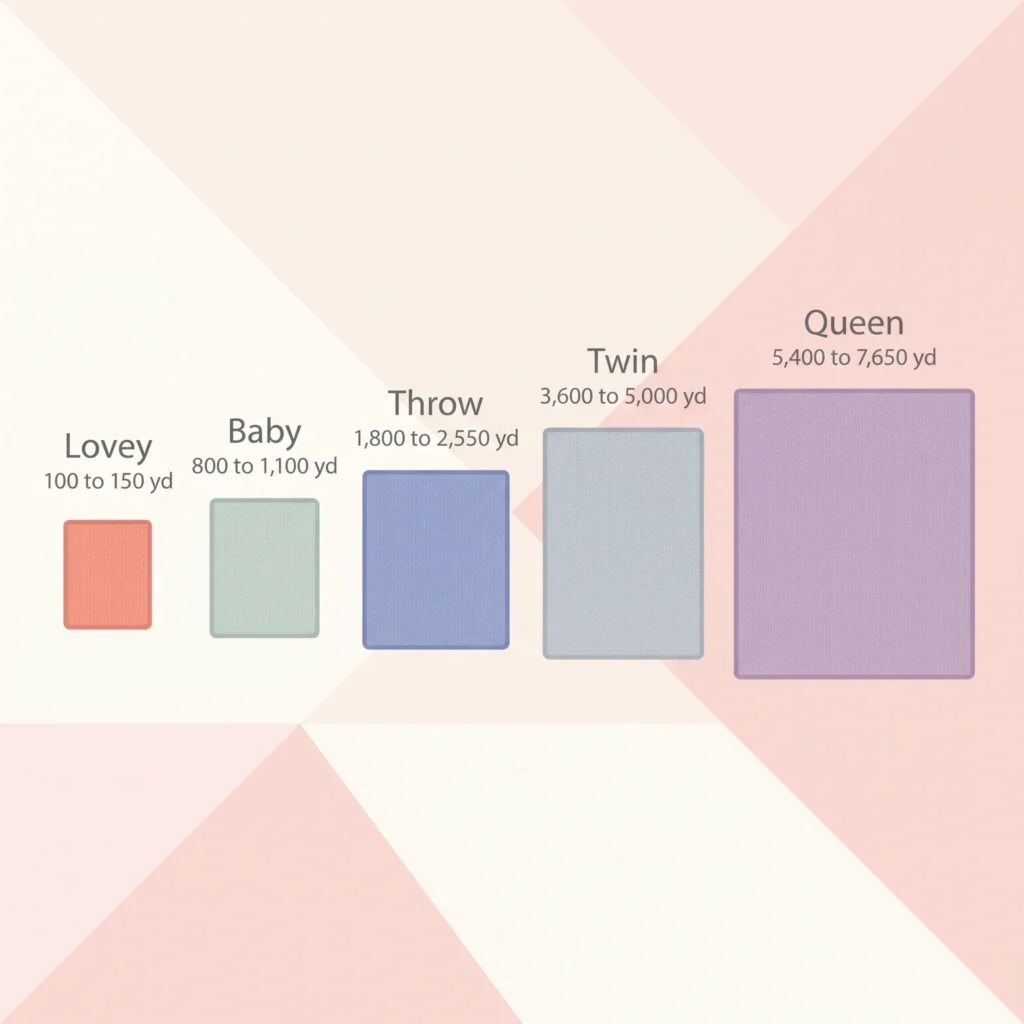
This chart shows typical yarn amounts for each blanket size in worsted weight yarn, using basic stitches such as single, half double and double crochet. Skein counts assume a standard 219 yard (200 meter) skein, before adding any extra.
| Blanket type | Size (inches) | Yarn needed (yards) | Skeins (219 yd) |
|---|---|---|---|
| Lovey | 12 × 12 | 100 to 150 | 1 |
| Stroller blanket | 30 × 35 | 650 to 900 | 3 to 5 |
| Baby blanket | 36 × 36 | 800 to 1,100 | 4 to 6 |
| Throw | 50 × 60 | 1,800 to 2,550 | 9 to 12 |
| Twin | 66 × 90 | 3,600 to 5,000 | 17 to 23 |
| Full or double | 80 × 90 | 4,300 to 6,100 | 20 to 28 |
| Queen | 90 × 100 | 5,400 to 7,650 | 25 to 35 |
| King | 108 × 100 | 6,500 to 9,200 | 30 to 42 |
Why the range? The lower number fits looser crocheters and taller stitches like double crochet. The higher number fits tighter crocheters and denser stitches like single crochet. If you’re using a textured stitch, plan to go above the top of the range.
A real example from our own patterns: our textured crochet blanket pattern makes a 43 × 60 inch throw in worsted weight yarn and uses about 2,761 yards. That’s more than a plain blanket of the same size would need, because its raised post stitches and 24 tassels use extra yarn. It’s a good reminder that stitch choice matters.
How Yarn Weight Changes the Amount
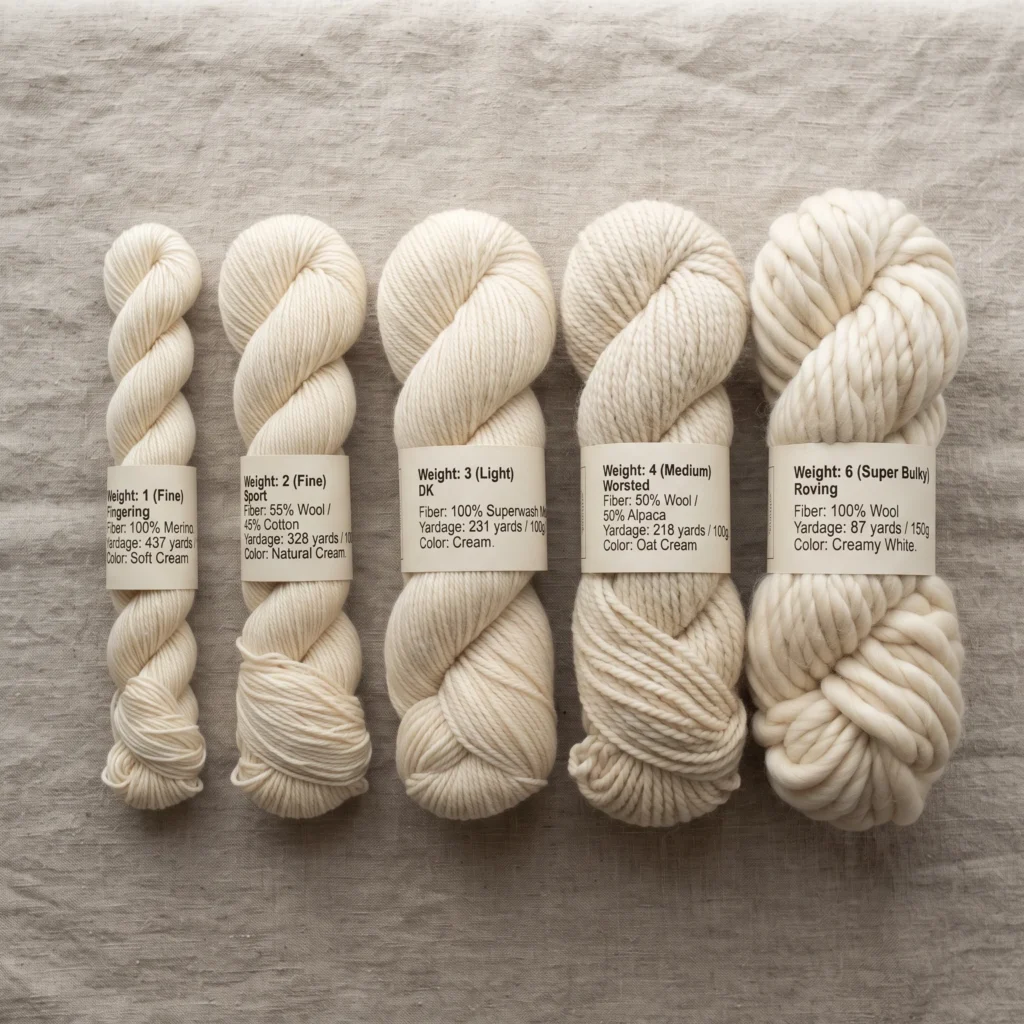
Yarn weight is the single biggest factor after size. Thicker yarn covers more area per stitch, so you need fewer yards. Thinner yarn needs many more yards to cover the same space.
Yarn weights are usually grouped from 0 to 7 using the standard yarn weight system from the Craft Yarn Council, which you’ll see as a small numbered symbol on most yarn labels. This chart compares each weight to worsted, using a 50 × 60 inch throw as the example.
| Yarn weight | Symbol | Compared with worsted | Throw example (yards) |
|---|---|---|---|
| Fingering or lace | 0 to 1 | about 3 times as much | 5,400 to 7,650 |
| Sport | 2 | about 1.6 times as much | 2,900 to 4,100 |
| DK | 3 | about 1.5 times as much | 2,700 to 3,800 |
| Worsted or aran | 4 | baseline | 1,800 to 2,550 |
| Bulky | 5 | about 0.6 times as much | 1,100 to 1,550 |
| Super bulky | 6 | about 0.35 times as much | 650 to 900 |
| Jumbo | 7 | less again | varies widely by brand |
Fewer yards doesn’t always mean cheaper. Bulky and super bulky skeins hold far fewer yards than worsted skeins, and they often cost more per yard. A chunky blanket may need fewer yards but a similar number of skeins. Always compare the total cost, not just the yardage.
Bulky yarn is faster, though. If you want a cozy blanket finished quickly, chunky yarn is hard to beat. Our easy crochet blanket pattern uses a jumbo hook and thick yarn, so a full throw grows quickly with just a simple four row repeat.
How Your Stitch Changes the Amount
Your stitch choice affects yarn use more than most people expect. Here’s how common blanket stitches compare, roughly, for the same finished size.
Single crochet creates a dense, sturdy fabric and uses the most yarn of the basic stitches. Many crocheters find a single crochet blanket uses about 20% to 30% more yarn than the same blanket in double crochet.
Half double crochet sits in the middle. It’s a popular choice for blankets because it balances speed, warmth and yarn use.
Double crochet is taller and slightly more open, so it covers more area with less yarn. It’s also faster, which is why so many blanket patterns use it.
Moss stitch and linen stitch combine single crochet with chain spaces. They create a beautiful woven texture and use a similar amount of yarn to plain single crochet, sometimes slightly less.
Granny stitch works in clusters with spaces between them. The open texture often uses a little less yarn than solid stitches. Our granny square blanket pattern uses super bulky yarn, so it grows especially quickly.
Corner to corner (C2C) uses small blocks of double crochet worked diagonally. Yarn use is similar to double crochet, though color changes in picture blankets can add extra for the tails.
Textured stitches such as puff, bobble, popcorn, waffle and post stitch cables stack extra loops into each stitch. They can use 30% to 60% more yarn than plain stitches. If you’re making a heavily textured blanket, plan generously.
Chevron and ripple stitches use a similar amount to the base stitch they’re built from, usually double crochet. Our chevron crochet blanket pattern is a good example of a striking blanket that doesn’t need extra yarn for its zigzag.
How Tension and Hook Size Affect Yarn
Tension is how tightly or loosely you crochet, and it quietly changes how much yarn you use.
Tight crocheters make smaller, denser stitches. They need more stitches, and more yarn, to cover the same area.
Loose crocheters make bigger, more open stitches. They cover more area with less yarn.
Hook size works the same way. A larger hook makes bigger stitches and uses less yarn per square inch, while a smaller hook makes denser fabric that uses more.
Tension also shifts during a big project. Many crocheters start tight when they’re concentrating, then relax as the rows become familiar. That’s one reason blankets sometimes use more yarn at the start than you’d expect, and it’s also why some blankets get wider as they grow. If that happens to you, our guide on why crochet gets wider or curls explains how to fix it.
The simplest way to account for your personal tension is to crochet a swatch, which brings us to the most accurate method of all.
How to Work Out Yarn for Your Own Blanket
Charts give you a good starting point, but a swatch gives you a number made for you. It takes about 20 minutes and can save you from buying the wrong amount of yarn.
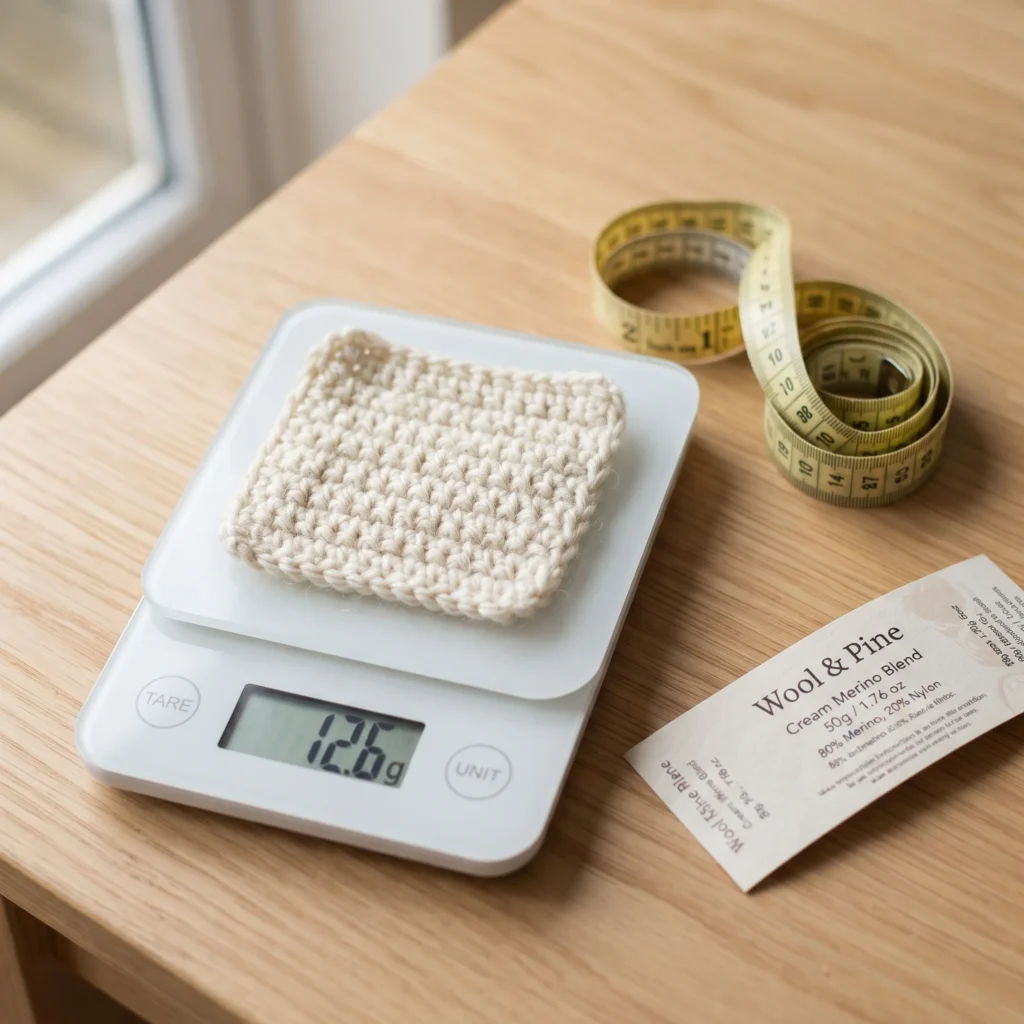
Step 1. Make a swatch. Using your chosen yarn, hook and stitch, crochet a square at least 6 × 6 inches. Larger is more accurate, so 8 × 8 inches is even better.
Step 2. Measure the yarn it used. You can do this in two ways:
- By length: before you start, measure out a long length of yarn, such as 40 yards, and mark the end. When the swatch is finished, measure what’s left and subtract it.
- By weight: weigh the finished swatch on a kitchen scale in grams. Then check your yarn label for the yards per gram. For example, a 100 gram skein of 219 yards has about 2.19 yards per gram.
Step 3. Work out yarn per square inch. Divide the yarn used by the area of your swatch. A 6 × 6 inch swatch has an area of 36 square inches.
Step 4. Multiply by your blanket area. Multiply your yarn per square inch by the area of your finished blanket.
Step 5. Add extra. Add 10% to 15% for the border, weaving in ends and natural tension changes.
A worked example
- Your 6 × 6 inch swatch uses 25 yards of yarn.
- 25 ÷ 36 = about 0.69 yards per square inch.
- Your throw is 50 × 60 inches, so its area is 3,000 square inches.
- 0.69 × 3,000 = about 2,083 yards.
- Add 15% extra: 2,083 × 1.15 = about 2,396 yards.
- With 219 yard skeins: 2,396 ÷ 219 = 10.9, so buy 11 skeins.
Keep your swatch afterwards. It’s useful for checking your gauge against the pattern and for testing how the yarn washes before you commit to a whole blanket.
Use the Free Crochet Yarn Calculator
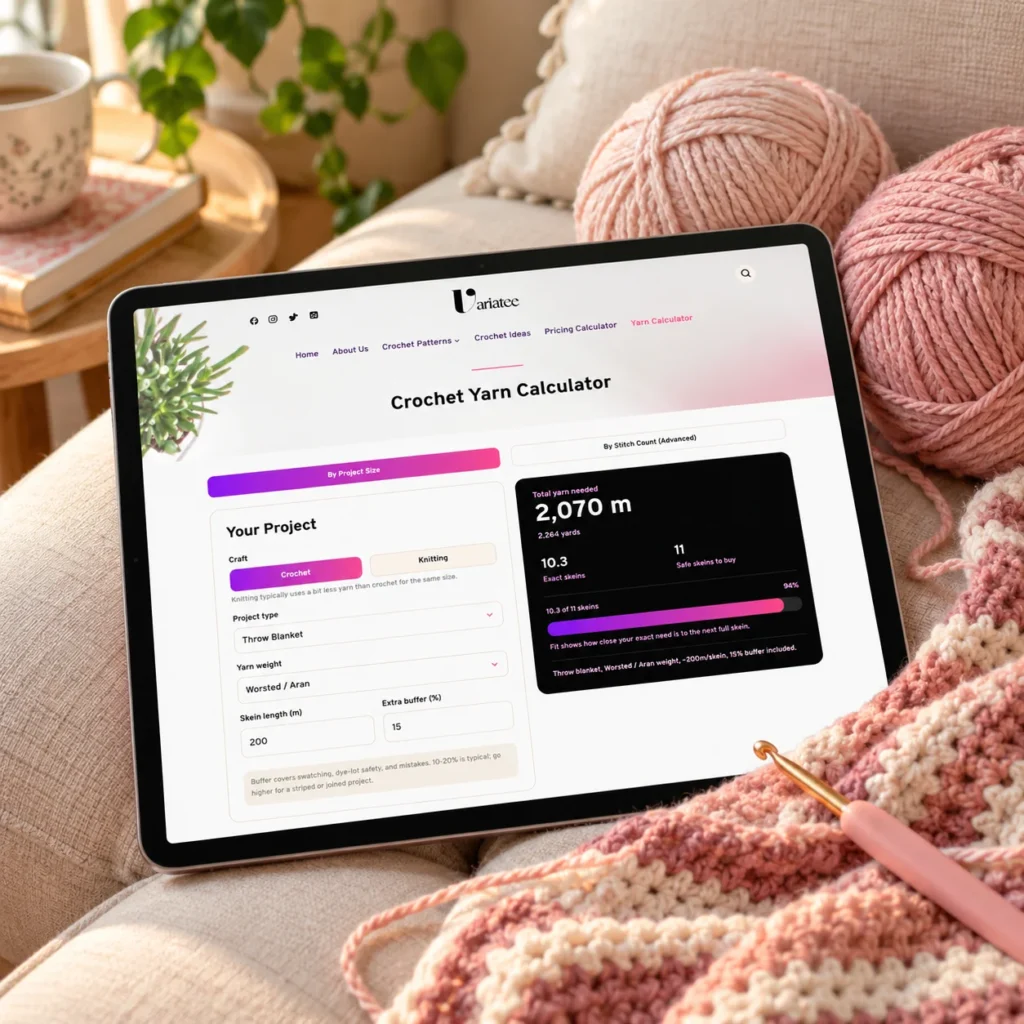
If you’d rather skip the math, our yarn calculator does it for you. It has two modes, so it works for almost any blanket.
By project size. Choose a blanket type, from a baby blanket up to a king size bed blanket, or enter your own custom dimensions. Pick your yarn weight and skein length, and the calculator shows the total yards and meters, the exact number of skeins and a safe number of skeins to buy with a buffer built in.
By stitch count. If you’re making a graphghan, a tapestry crochet blanket or a corner to corner picture blanket, you can enter your total stitch count and stitch type instead. This mode is especially useful for charted designs, where you know exactly how many stitches you’ll make.
The calculator is free, quick and designed around the same principles in this guide, so you can trust the numbers and buy your yarn with confidence.n compare prices for every place you sell. It’s free, quick and designed to help you charge what your work is truly worth.
How Many Skeins to Buy
Once you have your estimate, a few simple rules help you turn it into the right number of skeins.
Add a 10% to 15% buffer. This covers your swatch, the border, weaving in ends and any changes in tension. For small blankets, 10% is usually enough. For large blankets, go closer to 15%.
Plan extra for borders, fringe and tassels. A simple border of a few rounds can add around 5% to 10% to the yarn for a throw. Fringe and tassels use more than people expect, so if your pattern includes them, add an extra skein or two.
Always round up. You can’t buy part of a skein, so round up to the next whole skein, even if the calculation says 10.1.
Check the yardage on your label. Don’t assume all skeins are the same. Divide your total yards by the yards on your specific skein label to get an accurate count.
Keep your receipt and labels. Many shops accept unopened skeins as returns. Buying one extra skein and returning it unopened is much less stressful than running out.
Dye Lots and How to Avoid Mismatched Yarn
A dye lot is a batch of yarn dyed at the same time. Even in the same color, yarn from different dye lots can look slightly different, sometimes a shade lighter, darker or warmer. In a blanket, that difference can show up as a visible stripe where you joined a new skein.
Buy all your yarn at once. This is the best way to make sure every skein comes from the same dye lot. Check the dye lot number on each label before you buy.
Keep one label. Save a label from your yarn so you can find the exact color and dye lot again if you need it.
Alternate skeins if you have to mix lots. If you must use two dye lots, don’t switch all at once. Instead, alternate between the old and new skeins every two rows for a while. This blends the difference so it’s much harder to spot.
Plan color changes at natural breaks. If your blanket has stripes or blocks, try to use any slightly different skein for a whole stripe or square, where the change looks intentional.
Not all yarn has dye lots. Many acrylic yarns are labeled “no dye lot,” which means the color is consistent across batches. That can be a real advantage for big blankets.
Planning Yarn for Striped and Multicolour Blankets
Striped, color block and multicolour blankets need a little more planning, because you’re buying several colors rather than one.
Start with the total. Work out the total yarn for the whole blanket first, using the charts or your swatch.
Split it by color. Estimate what share of the blanket each color covers. In a blanket with equal stripes of four colors, each color covers about a quarter, so each needs about a quarter of the total. If one color is a wide background and the others are thin accents, give the background a much bigger share.
Round up for every color. Add your 10% to 15% buffer to each color separately, then round up to whole skeins. Running out of one accent color is just as frustrating as running out of the main one.
Allow extra for tails. Every color change leaves two yarn tails to weave in. In a blanket with many stripes, those tails add up, so a little extra for each color is wise.
Choose your border color early. Borders are often worked in one of the stripe colors. Decide which one before you buy, and add the border yarn to that color.
What to Do If You Run Out of Yarn
Running out of yarn halfway through a blanket is stressful, but it’s almost always fixable. Here are your options.
Search for the same dye lot. Check other shops, online retailers and community marketplaces such as the Ravelry stash pages, where crocheters sometimes sell leftover yarn. Search using the exact color name and dye lot number from your label.
Alternate old and new skeins. If you can only find a different dye lot, blend them by alternating every two rows, as described above.
Add a contrast border. Finish the blanket in a coordinating color that frames the design. Done well, it looks like it was planned from the start.
Add stripes. Work a few stripes in a complementary color through the remaining section, and repeat them elsewhere if needed to balance the design.
Make it a little smaller. If you’re close to the end, a slightly shorter blanket might be perfectly fine, especially for a throw.
Of course, the best fix is prevention. Use the swatch method or the crochet yarn calculator before you start, and buy a little extra.
Choosing the Best Yarn for a Blanket
The yarn you choose affects how much you need, how the blanket feels and how it lasts.
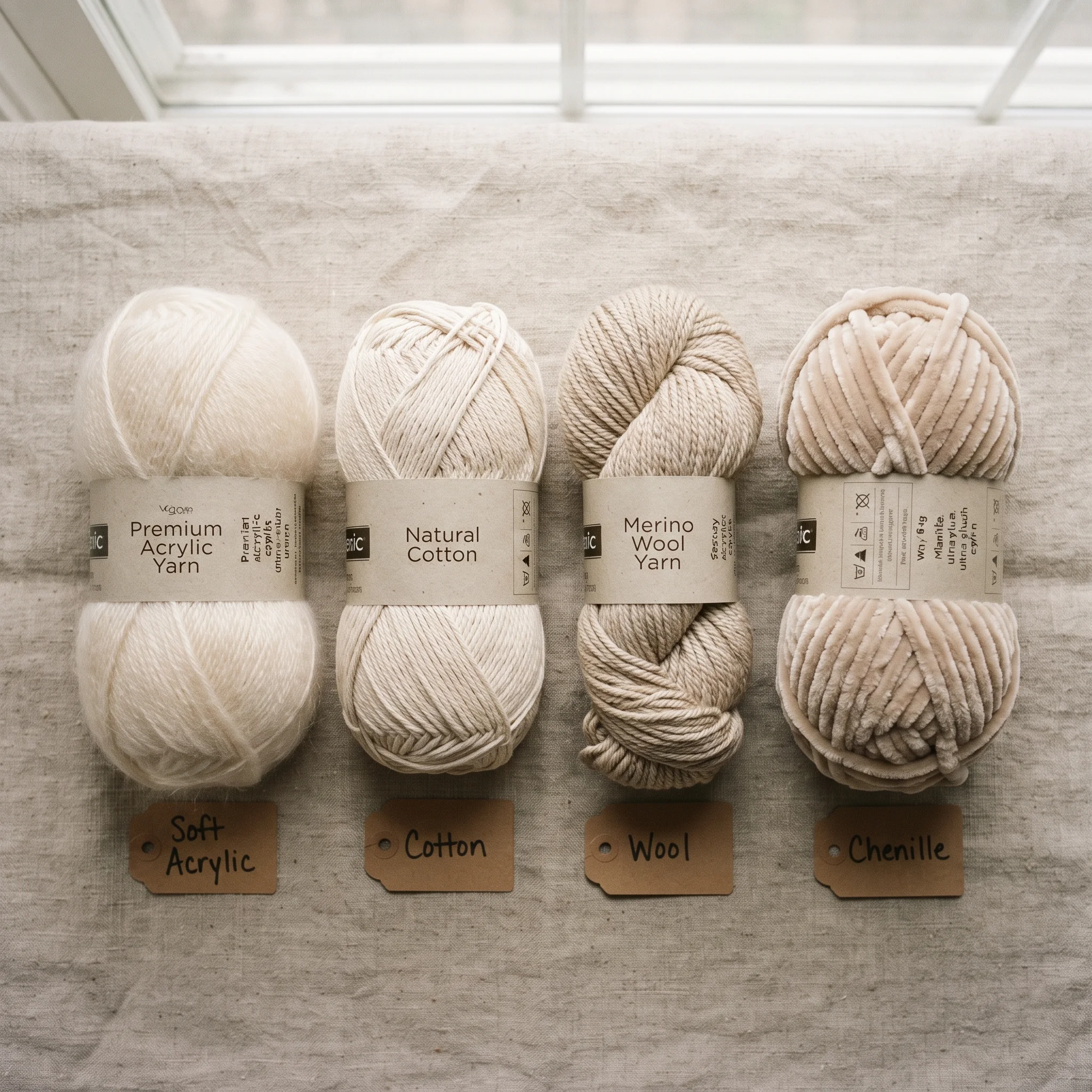
Acrylic is affordable, soft, machine washable and available in hundreds of colors. It’s the most popular choice for everyday blankets and anything for children.
Cotton is breathable and strong but heavier than acrylic. A cotton blanket can feel weighty, which some people love. It’s great for summer throws and baby blankets in warm climates.
Wool and wool blends are wonderfully warm and springy, with beautiful stitch definition. Choose a superwash wool if the blanket needs to go in the washing machine.
Chenille and velvet yarns are plush, soft and quick to work up in chunky weights. They can be slippery to crochet, so they’re best once you’re comfortable with your stitches.
For baby blankets, choose a soft, machine washable yarn that’s gentle on delicate skin. Avoid very fluffy or loosely spun yarns that might shed. Our baby blanket crochet pattern uses DK or light worsted yarn for a soft, practical blanket that washes beautifully.
How Much a Crochet Blanket Costs in Yarn
Yarn is the biggest material cost in any blanket, so it’s worth planning your budget before you start.
As a rough guide, if worsted acrylic costs $5 to $8 per 219 yard skein, a throw needing 10 to 12 skeins will cost around $50 to $96 in yarn. A queen blanket needing 30 skeins could cost $150 to $240. Wool, cotton and specialty yarns cost more.
If you’re making a blanket to sell, that yarn cost is only the beginning. Your time is the biggest part of a handmade blanket’s value, and a throw can easily take 25 to 40 hours. Our guide on how much to charge for crochet items shows you how to turn your yarn cost and time into a fair price, and the crochet pricing calculator does the math for you.
Quick Answers to Related Blanket Questions
Once you know how much yarn your blanket needs, these questions usually come next. Here are short answers, with links to our detailed guides.
Yarn for a Corner to Corner Blanket
C2C blankets are built from small blocks of double crochet, so they use a similar amount of yarn to a double crochet blanket of the same size. Picture and graphghan designs add extra for color changes and tails. If you’re working from a chart, the stitch count mode in our yarn calculator gives the most accurate estimate, and our upcoming guide on calculating yarn for C2C and graphghan blankets goes into detail.
Yarn for a Granny Square Blanket
Granny square blankets use a little less yarn than solid stitches because of their open clusters. A throw made from worsted granny squares often needs around 1,600 to 2,300 yards. The joining method matters too, since joining with a separate color adds extra. Our granny square blanket pattern gives exact amounts for a chunky version.
Yarn for a Crochet Sweater
An adult sweater in worsted weight yarn usually needs around 1,000 to 2,000 yards, depending on size, length and sleeves. Larger sizes and longer sleeves need more. Our upcoming guide on how much yarn you need for a crochet sweater breaks it down by size, and our crochet sweater patterns include yarn amounts for every size.
Yarn for Hats, Bags and Amigurumi
Small projects need much less yarn. A worsted beanie usually needs around 150 to 200 yards, a tote bag around 200 to 400 yards and a small amigurumi often less than one skein. Our upcoming guide to yarn for hats, bags and amigurumi covers each in detail.
Yarn Weights and Substitutions
If you’re swapping the yarn in a pattern, match the weight first, then check the gauge. Swapping to a different weight changes the size of your blanket and the amount of yarn you need. Our upcoming guide to yarn weights and substituting yarn explains how to swap safely.
Crochet Compared With Knitting
Crochet generally uses more yarn than knitting for the same area, often around a quarter to a third more, because crochet stitches are thicker and stack more loops. If you’re converting a knitted blanket idea into crochet, plan for extra yarn.
Finishing Your Blanket
Once your blanket is finished, blocking helps even out stitches, straighten edges and improve drape. It’s especially helpful for lacy, textured and granny square blankets. Our guide on how to block crochet blankets, granny squares and sweaters shows you how, step by step.
Frequently Asked Questions
Buy Your Yarn With Confidence
The question of how much yarn a crochet blanket needs doesn’t have one single answer, but it does have a clear method. Start with a reliable range for your blanket size, adjust it for your yarn weight and stitch, and confirm it with a quick swatch. Then add 10% to 15% extra and buy everything from the same dye lot.
Follow those steps, and you’ll start every blanket knowing you have enough yarn to finish it beautifully.
Ready to plan your next blanket? Use our free yarn calculator to get your exact number, then browse our free crochet blanket patterns to find the perfect project.
Work Out Your Yarn in Seconds